
A personal career coach for professionals starting over
Turn a career transition from a lonely guessing game into a guided path through tailored recommendations, real mentors, and a community that's been there.
Have you ever wondered what your life would be like
if you chose a different career?
For years as a teacher, my focus was on helping others find their path. But when it came time to navigate my own pivot into product design, I hit a wall. I was drowning in fragmented advice and generic job boards that completely ignored the skills I already had. The whole process felt incredibly lonely, and it left me with one question:
Why is changing careers so difficult, even for experienced professionals?
41% of the workforce is ready to pivot, but the system leaves them stranded
Changing careers is no longer the exception. Most people will do it several times, and a significant share keep doing it late into their working lives. Yet the support around them is still built for a first job, not a fourth: it assumes you already know the destination and only need help applying. For someone leaving an established career, the hard part is deciding what to move toward, and who can tell them what that work is actually like. That gap is what this project set out to close.
What already exists, and what people actually said
The market serves job seekers, not career changers
I audited 17 different career platforms across Canada. The pattern was clear: current solutions cater to people who already know their exact next step.
Products assume users just need another generic job board or are willing to pay for expensive private coaching.
Standalone mentorship networks lack the context a mid-career pivot needs, leaving space for a platform that connects resources with the right mentors.
The hidden cost of a career pivot
I spoke with three professionals who made drastic career leaps. Their stories revealed a shared reality: without an accessible network, transitioning is a lonely and unnecessarily time-consuming process.
— A massage therapist who navigated multiple occupations, from horse keeping to sales."Some sort of mentorship is so important when going through transitions."
— An artist who transitioned from marine biology."I did everything on my own, which cost me a lot of time."
— A software developer student transitioning from childcare education."I would have liked to meet someone who works in the field that I was interested in to hear about the actual work environment."
All three wanted a connection with someone already working in their target field. Without one, building a new path came down to trial and error.
The three core frictions stalling career transitions
No personalized starting point
Advice is everywhere, and none of it is tailored to a specific background or the skills that would carry over.
Mentorship is a closed network
Finding someone who has made the same move usually depends on already knowing them.
No real‑world context
There are few places to ask what the work is actually like day to day and get an answer from someone doing it.
Cutting the noise: prioritizing the right features
I mapped out every possible feature to solve these frictions. Reviewing that ideation with a career expert, we saw the product risking feature bloat, so we cut the passive and out-of-scope ideas and kept only what users could act on.
Instead of sending users away to take external personality tests, we focused on gathering their actual experience and skill sets directly to provide immediately curated resources.
We removed formal career coaches and psychologists from the scope. The priority was creating a space for peer networking and direct connections with industry mentors.
Reading about someone else's success does not provide practical help. We replaced one-way inspirational speeches with an active forum where users can ask real questions and get informative answers.
Three lists looked thorough. One was easier to act on.
The first sketches split career recommendations three ways: one set from work experience, one from skills, one from interests. It meant holding three lists at once and working out why the same job appeared in two of them. Thorough for me, not for the person deciding what to do next.
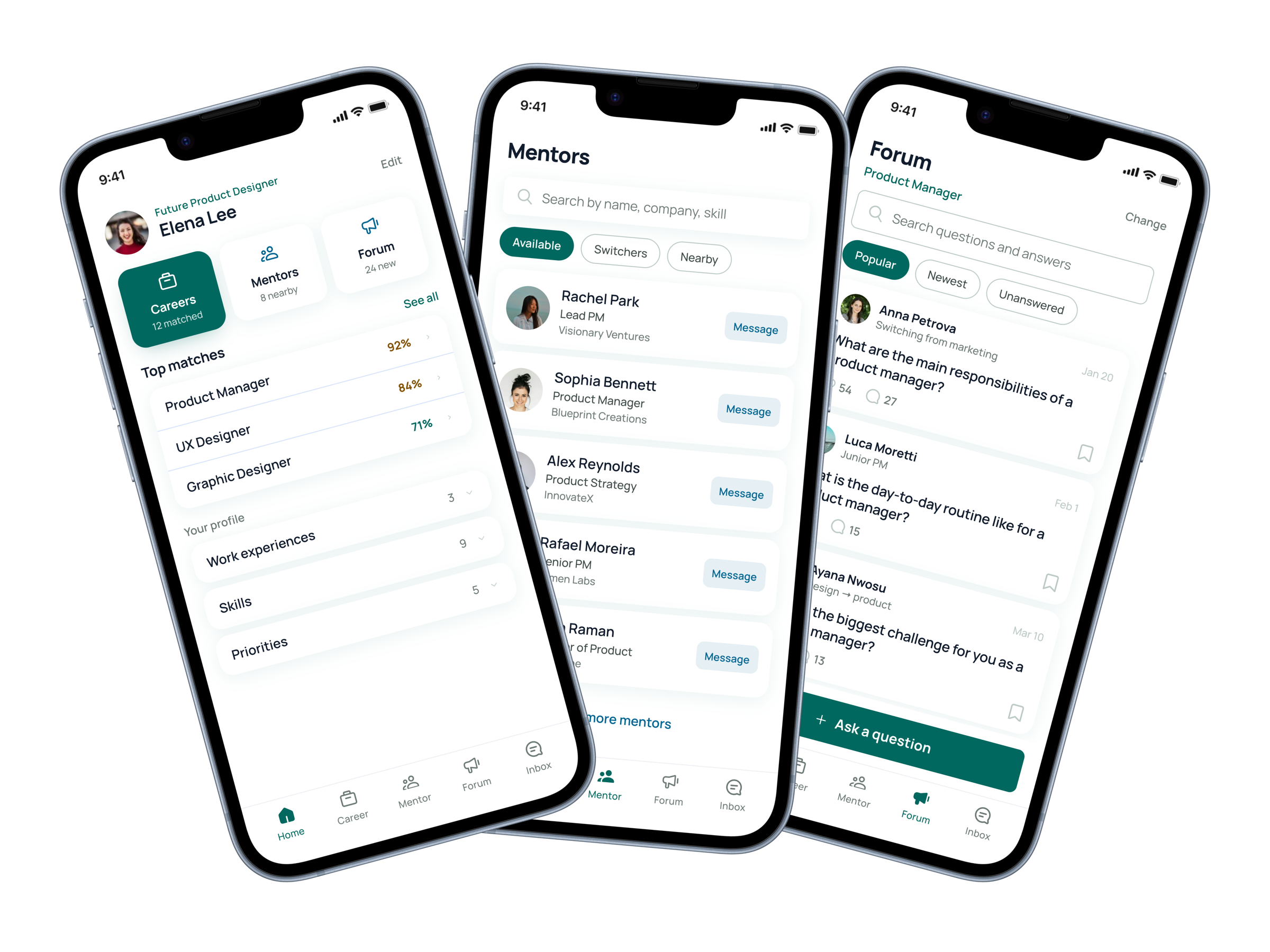
The high-fidelity version keeps one ranked list, with load more underneath and a search field for anyone who already knows what they are looking for.
Three moves, one for each friction
Personalization drives the fit, mentors close the network gap, and the community supplies the real‑world context generic platforms don't.
Tailored recommendations, not a job board
A pivot takes more than matching past job titles. Onboarding captures professional skills, soft skills, and workplace priorities, and that profile drives every career match percentage and mentor suggestion on the platform.
Direct access to industry mentors
Getting into a new field usually means knowing the right people. This opens closed networks by connecting users directly with established professionals in their target industry. Because cold outreach is intimidating, they can send a short message for a quick question or a structured request for long-term mentorship.
A community that's already been there
Career transitions feel isolating. The forum gives users a place to ask questions and read real stories from peers who have made the same move, and switching between career topics keeps exploration open.
Where it landed
Testing across both in-person and online sessions strongly validated the product's direction. While revealing a few minor visual and text elements to refine, participants successfully completed the tasks and shared overwhelmingly positive feedback.
"Getting recommendations based on my specific skills and preferences really feels like having a personal career coach at hand."
— User testing participant"The flow is so straightforward. For the first time, figuring out my next career move felt manageable instead of completely overwhelming."
— User testing participantBuilding a tool designed to solve a directly experienced problem was deeply satisfying. Seeing that exact value translate to the users made the entire journey incredibly meaningful.
Three things I'm taking forward
Prioritizing local market context
Career transition tools need to reflect the realities of the local job market. Bringing in region-specific labour data, standards, and resources can make recommendations more relevant and actionable.
Making the most of expert collaboration
Working with a subject matter expert taught me to communicate with greater focus. With limited time, clearly framing the right questions helps make each conversation more meaningful and productive.
An open question about the business model
How might the platform build and retain an active mentor community at scale? Creating a sustainable model for mentor participation remains an important next step for long-term service delivery.

eatt (everyone at the table)
Allergy info scattered across texts risked a missed reply. We built a way to collect it and recommend safe menus.
Cudagra
2,000 people had signed up, but almost nobody was playing. We redesigned the profile and invite flow around trust.

Creating a Path to Well-Being in the Social Media Maze
Social media's effect on well-being is tangled and contradictory. Mapped it to find where the system can be moved.